‘It is a nightmare.’ Former refugee, professor on Trump’s new Medicaid coverage : NPR
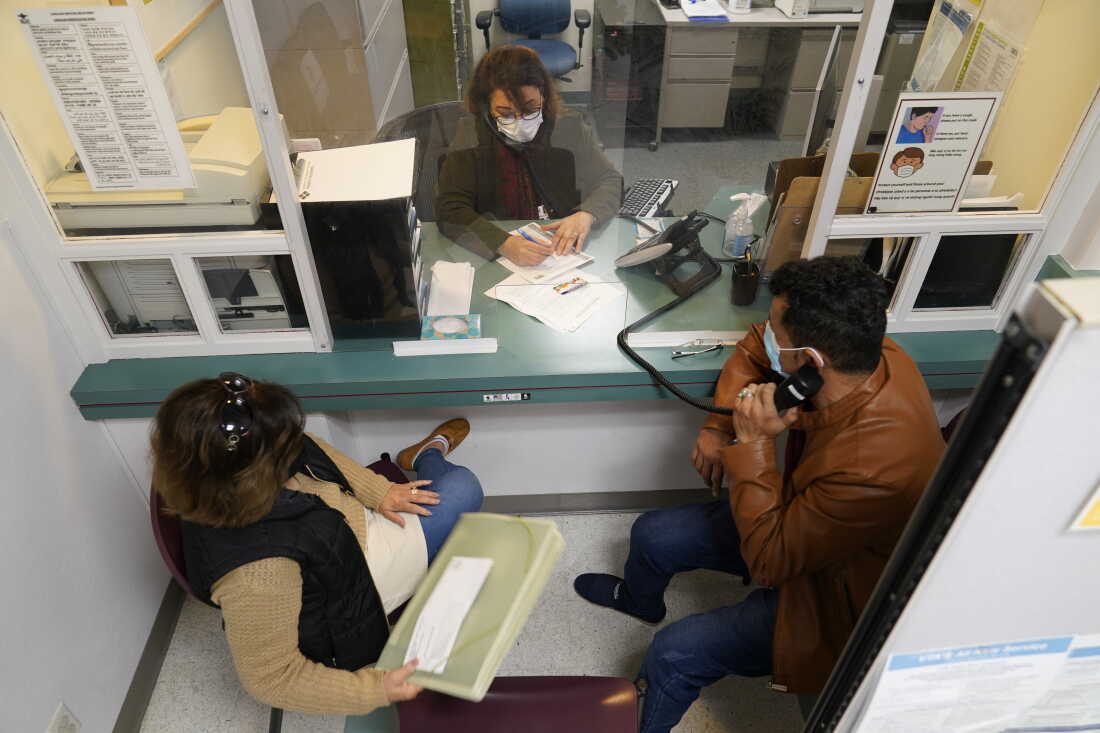
Mohammad Attaie and his spouse Deena, newly arrived from Afghanistan, get help from medical translator Jahannaz Afshar making a physician’s appointment on the Valley Well being Middle TB/Refugee Program in San Jose, Calif., on Dec. 9, 2021.
Eric Risberg/AP
conceal caption
Eric Risberg/AP
Mustafa Rfat has been getting frantic telephone calls just lately from refugees with disabilities. As of Oct. 1, refugees are shedding entry to Medicaid throughout the nation due to H.R. 1, the Trump administration’s main price range invoice Republicans handed final summer season.
“I spent these previous two weeks simply speaking with so a lot of them, actually simply terrorized by the fact that their youngsters with disabilities are shedding protection,” he says. “For instance, a father is a refugee with disabilities, with two children with disabilities, and he is simply confused how he will get the remedy.”
Rfat is a professor of social work on the College of Nebraska at Omaha, and his analysis focuses on refugees with disabilities, an expertise he is aware of firsthand.
When he arrived within the U.S. as a refugee from Iraq in 2011, the continual situation that impacts his backbone was extreme. “I used to be in a really unhealthy state of affairs,” he says. “I could not stroll. I used to be in a lot ache. I missed my drugs for a very long time. I did not see a physician. So it was a really, very tough and susceptible state of affairs.”
When Mustafa Rfat arrived within the U.S. as a refugee from Iraq in 2011, the continual situation that impacts his backbone was extreme. He says Medicaid was a lifeline for him. Now, he is making an attempt to assist refugees with disabilities going through the challenges of navigating life within the U.S. with out that lifeline.
Mustafa Rfat
conceal caption
Mustafa Rfat
As he moved from Alabama to Illinois to West Virginia looking for housing and proceed his schooling, Medicaid was a lifeline, Rfat says. “I needed to climb this large mountain of acclimating into the tradition right here, studying English, coping with the traumas of the warfare, the lack of relations, the challenges that I confronted, being alone with a incapacity,” he says.
“I used to be decided and on this willpower, Medicaid was the massive issue that made my desires come true.” The truth is, he says one of many specialists who handled him wrote his first reference to use for school. He has since develop into a U.S. citizen with a household, a doctorate, and a job as a professor.
Now, he is making an attempt to assist refugees with disabilities going through the challenges of navigating life within the U.S. with out that lifeline. As of Oct. 1, refugees are among the many teams that may lose Medicaid protection.
A whole lot of 1000’s will lose protection
Solely a small portion of authorized immigrants have been eligible to enroll in Medicaid, together with refugees and asylum seekers. Due to the modifications to “Alien Medicaid Eligibility” within the One Massive Stunning Invoice Act that Republicans handed final summer season, a good smaller subset now have entry. An estimated 280,000 individuals will lose Medicaid in October, in accordance with an evaluation by KFF Well being Information.
That features immigrants admitted to the U.S. on humanitarian grounds who’re ready to be accredited for a inexperienced card, explains Ben D’Avanzo, senior strategist on the Nationwide Immigration Legislation Middle.
“The people who find themselves shedding Medicaid and CHIP [the Children’s Health Insurance Program] are amongst among the most susceptible immigrants — individuals who have skilled violence in their very own properties or on their journey, who could have bodily and psychological situations, who’re fleeing persecution and warfare,” he says. “These are individuals who we’ve got lengthy, in the USA, welcomed, and populations who’ve had very sturdy, historic bipartisan help.”
Rfat factors out that refugees usually tend to have critical well being situations than different teams. “Multiple third of them have a minimum of one kind of incapacity — that is what the analysis tells us,” he explains. In refugee camps and through warfare entry to docs and drugs is tough, and easy situations can develop into critical and complicated.
That was his personal expertise with an inflammatory situation referred to as ankylosing spondylitis. “By the point I arrived within the U.S., loads of docs advised me, ‘You might be one of many worst circumstances that we’re seeing,'” he says. “And that’s the case for lots of refugees that come right here.”
In an announcement to NPR, the Facilities for Medicare and Medicaid Providers wrote that they’re enacting the regulation handed by Congress working with states to precisely implement the coverage. They didn’t reply to a observe up query in regards to the impact of the coverage on refugees with disabilities.
“As soon as these modifications happen, these teams of immigrants might be left with only a few choices for inexpensive, complete protection,” says Drishti Pillai, director of immigrant well being coverage on the nonpartisan well being analysis group KFF.
“They may nonetheless purchase full worth protection from ACA marketplaces, however that’s usually unaffordable,” Pillai says. “Employer-sponsored protection can be an choice, however many immigrants, particularly those that are on Medicaid, do not work in jobs that do not supply employer-sponsored protection, akin to jobs in building, agriculture, meals service.”
She says just a few states are creating their very own protection choices for these teams, however many have tight budgets and are going through even larger Medicaid cuts in January. Most states have additionally opted in to permit Medicaid to proceed to cowl pregnant girls and youngsters who would in any other case be shedding protection.
D’Avanzo factors out that the classes of individuals shedding protection now will finally develop into inexperienced card holders who’re eligible for Medicaid.
“So these are people who find themselves going to place off preventative care, who aren’t going to deal with their continual situations, who’re going to forgo necessary remedy,” he says. “After which when they’re Medicaid eligible once more sooner or later, as soon as they’ve obtained their inexperienced card, they will be needing far more specialised care and far more pricey care.”
Hope for change
Mustafa Rfat is headed to his alma mater Washington College in St. Louis, Missouri this weekend to fulfill with just a few dozen refugees with disabilities and share a few of his latest analysis. He says the lack of Medicaid and meals advantages will dangle over the occasion.
“It is a nightmare for the neighborhood,” he says. He hopes Congress will reverse course.
He is determined to dedicate a part of the occasion to educating about civic engagement. “To know the significance of voting once they develop into residents, to know the significance of being conscious of the insurance policies, being conscious of who their representatives are, talk with their representatives,” he says.
“These are new Individuals,” he provides. “These persons are going nowhere. By making their well being and well-being worse, it is not going to profit anybody.”