They sleep on the sidewalk whereas a liked one is hospitalized : NPR
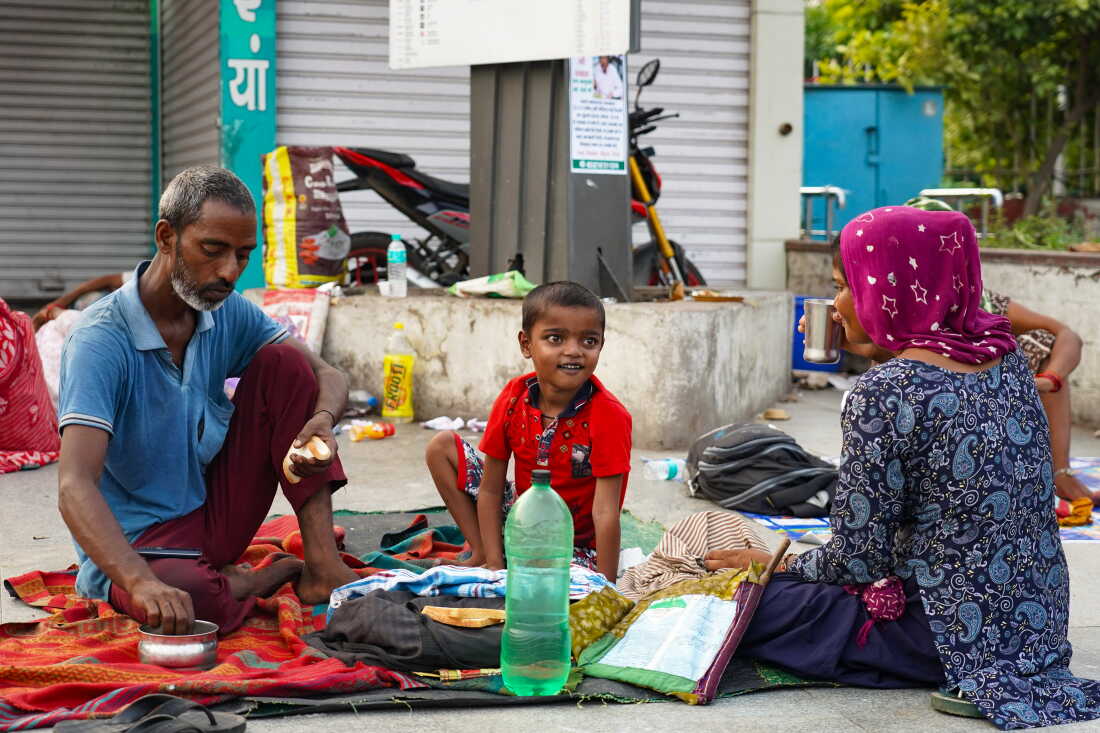
Balraam Singh, 35, eats breakfast along with his spouse, Nusaa Davii, and their 7-year-old son, Munna, on the pavement exterior Safdarjung Hospital in New Delhi, India. The kid is receiving therapy for a coronary heart situation, and the household has been sleeping on the pavement exterior the hospital for the previous 20 days.
Sajad Hameed for NPR
disguise caption
Sajad Hameed for NPR
DELHI, India — At 2 a.m. on the sidewalk exterior considered one of Delhi’s best-known public hospitals, Shabana Kumar gently wakes her husband. They sleep in shifts of about an hour at a time as a result of their 6-year-old son is a affected person within the oncology ward, being handled for leukemia, a most cancers of the blood and bone marrow. They’re afraid that if they’re each asleep, an pressing name may come about their son’s situation they usually would possibly miss it.
The Kumar household lives greater than 600 miles from Delhi within the state of Bihar. Arun, 32, works as a farmer. Shabana, 30, is a homemaker caring for his or her solely son.
They made the journey to Delhi as a result of they might not afford the price of their kid’s most cancers therapy in Bihar. The All India Institute of Medical Sciences, or AIIMS, subsidizes bills for households in want.
However for a lot of households, there’s one problem they need to bear on their very own — discovering a spot to reside in Delhi in the course of the days, weeks, even months of therapy. Just like the Kumars, households who cannot afford to lease lodging typically arrange a brief dwelling on the sidewalk.
On an evening in August, dozens of households have been sleeping on blankets or sheets unfold instantly on the sidewalk. Some tie mosquito nets to railings to guard themselves and their youngsters. They maintain their baggage and different belongings beside them as they sleep.
Households who’ve family members being handled on the All India Institute of Medical Sciences in New Delhi attempt to get some relaxation. Hundreds of sufferers and their households journey from throughout India, generally 1000’s of kilometers, to hunt therapy on the hospital. Many who cannot afford lodging sleep on pavement, in subways and in different public areas close to the hospital whereas ready for appointments or therapy.
Sajad Hameed for NPR
disguise caption
Sajad Hameed for NPR
Through the day, households transfer between the sidewalk and the hospital for appointments, assessments, medicines and consultations. They carry their most necessary belongings with them whereas leaving much less worthwhile objects at their sleeping spot. One member of the family typically stays behind to control their issues.
Just like the household from Bihar, individuals who’ve accompanied a affected person might sleep exterior whereas the affected person is housed within the hospital. In different circumstances, the individual receiving care is seen in the course of the day however doesn’t have a mattress, so that they sleep on the sidewalk as effectively.
At night time, the sidewalk dwellers return to the pavement, the place a small ecosystem has grown across the households. Girls prepare dinner rice over makeshift brick stoves. Volunteers distribute meals. Close by outlets promote medicines and different requirements. Close by tea stalls not solely serve drinks however let households cost their telephones.
As soon as strangers, they alternate details about docs, assessments and the place to discover a free meal or, when none is accessible, an inexpensive one they will pay for.
Vishnu Singh, 38, serves tea to sufferers, caregivers and others exterior the hospital. Singh runs the stall along with his brother, Arjun, and retains it open 24 hours a day.
Sajad Hameed for NPR
disguise caption
Sajad Hameed for NPR
Vishnu Singh, 38, runs a tea stall exterior AIIMS.
“I see poor folks sleeping right here daily, so many who I can not even depend them,” he mentioned.
At AIIMS and Safdarjung Hospital, which is related to Vardhman Mahavir Medical School, we interviewed households who had traveled from throughout India, typically lots of of miles from residence, to hunt medical care. The 2 hospitals stand reverse one another, treating sufferers with sicknesses starting from most cancers and coronary heart situations to intestinal issues and different severe illnesses.
Some households had been there for per week, others for a month or longer. For a lot of, returning residence between hospital visits was impractical, so sufferers and the family members accompanying them stayed in Delhi throughout their care.
The households we spoke with described their experiences spending days or even weeks in Delhi whereas navigating appointments, assessments, consultations and therapy.
A household sleeps inside a subway close to the All India Institute of Medical Sciences in New Delhi, India. Many households who haven’t got a spot to remain sleep in public areas close to the hospital.
Sajad Hameed for NPR
disguise caption
Sajad Hameed for NPR
When therapy means dwelling exterior
It’s a startling distinction — a hospital that gives important care, that, based on its annual report, offers subsidies to 1000’s of poor households for therapy — and that’s ringed by people who traveled nice distances to seek out take care of a liked one and who can not afford a spot to remain.
NPR reached out to the hospital by electronic mail to ask in regards to the concern of lodging and the group of sidewalk dwellers. The hospital didn’t reply.
AIIMS’ web site notes that its Medical Social Service Unit supplies monetary help for medical therapy and journey prices for some sufferers coming from exterior Delhi. It additionally states that the unit helps organize lodging for out-of-town sufferers and their relations and caregivers at dharamshalas, conventional charitable lodging services affiliated with AIIMS, or different low-cost lodging.
The web site doesn’t say whether or not AIIMS pays for these lodging or supplies monetary help particularly for the lodging prices. Shalini Yadav is among the sufferers who sleeps on the sidewalk along with her dad and mom.
Shalini Yadav, 20, who’s searching for therapy on the hospital for an intestinal sickness that she’s suffered from for 5 to 6 years, passes the time studying The God of Sins.
Sajad Hameed for NPR
disguise caption
Sajad Hameed for NPR
Yadav is a second-year school pupil from Piprat village in Tikamgarh district, Madhya Pradesh, in central India. She had been making ready for the state civil service examination. Her plan was to change into a authorities officer.
Now she is spending her days studying Gunahon Ka Devta (The God of Sins), a well-known 1949 Hindi tragic romance novel written by Dharamvir Bharati, on the pavement exterior AIIMS, ready to seek out out when her therapy will start and when she will go residence.
Yadav says she has been coping with an intestinal sickness for 5 – 6 years and has already undergone two operations. Her household had sought therapy elsewhere earlier than family members and neighbors suggested them to journey to Delhi in the hunt for higher therapy at AIIMS — a visit of roughly 370 miles. “We thought AIIMS was the very best hospital in India,” she mentioned. The price of staying in Delhi was additionally a burden: Her household couldn’t afford a room and had already spent 1000’s of rupees on journey and different bills.
After we interviewed her on Aug. 3, she had been there for about three weeks along with her dad and mom, Surendra Singh Yadav, 47, a farmer, and Kalpana Yadav, 45.
“We thought the services can be good, the docs can be good, and every little thing would occur shortly. We by no means imagined that we must sleep on the highway,” she mentioned.
For her, the pavement is not only uncomfortable, it’s also scary. Through the day, she says, she will handle. At night time, she worries in regards to the folks round her.
“There are all types of individuals right here,” she says. “Some are good, however some drink or use medicine. There’s shouting and combating. As a lady, I really feel very uncomfortable right here at night time.”
However the household has little selection. They can not afford a room in Delhi, she says. “We have now determined that we have now to sleep on the highway as a result of there isn’t a different choice.”
Through the day, Yadav goes into the hospital for appointments, assessments and checkups, then returns to the pavement whereas ready for the following step in her therapy. The whole lot is on maintain — her school schooling, her hopes of qualifying for a authorities job, her father’s farming work.
“It seems like we’re being pressured to reside like this,” she says.
“I simply pray that I can meet a physician”
Lakhi Bai, 62, from Ramnagar in Maihar district, Madhya Pradesh, in central India, about 500 miles away, got here to Delhi searching for therapy for diabetes and a situation that she says causes numbness and a lack of sensation in components of her physique.
She says she may generally maintain an harm with out feeling ache. After we met her, she had been sleeping exterior Safdarjung Hospital for about 20 days. Throughout that point, she says, she had been going to totally different docs and departments for consultations and assessments however had not but obtained a therapy plan.
Bai is a farmer and describes herself as a homemaker. She mentioned she has three sons however is not in touch with them. She got here to Delhi alone.
Lakhi Bai, a 62-year-old farmer who got here to the hospital to obtain therapy for diabetes, has been sleeping exterior the hospital for about 20 days.
Sajad Hameed for NPR
disguise caption
Sajad Hameed for NPR
“I can not afford to deliver somebody with me,” she says. “If I deliver somebody, I’ve to pay for his or her meals and lodging, too.”
It has been a tough interval. “Typically I do not even get meals,” she says. “I sleep with an empty abdomen.”
Sleeping exterior can also be irritating. The warmth is difficult to endure, she mentioned, as is rainwater.
“When it rains, water comes right here,” she mentioned. “There’s nowhere to go.”
AIIMS didn’t reply to requests for remark about her account or the experiences described by different households interviewed for this story.
Bai didn’t know the way for much longer she must stay in Delhi. “I’ve no place to remain,” she says. “I simply pray that I can get the therapy I would like and one thing will be completed.”
A month exterior awaiting a toddler’s coronary heart therapy
In August, Balraam Singh, 35, a brick-kiln employee from Meerut, Uttar Pradesh, had been sleeping exterior Safdarjung Hospital for a couple of month along with his spouse and their 7-year-old son, Munna Singh.
Munna has a coronary heart situation that his father describes as a “gap within the coronary heart.”
They’d come from about 50 miles away searching for additional medical analysis and therapy at Safdarjung Hospital.
“We got here with quite a lot of hope that we might discover a physician and my son can be handled,” he says. “However now it seems like we might have to return with out figuring out what is going to occur subsequent.
For Singh, who can earn $5 to $7 a day on the kiln the place he works, staying in Delhi means not solely a lack of earnings however the necessity to spend cash on meals and different each day wants.
Six months of saving for an additional hospital go to
Gulshan Bano, 38, had come to Delhi from Bihar along with her 60-year-old mom, Asma Khatoon, and her 6-year-old daughter, Fiza. They’d been sleeping exterior Safdarjung Hospital for a couple of week after we met them in August.
Bano says her mom has had a coronary heart situation for a number of years and was receiving therapy in Bihar. Her mom had undergone checkups and assessments there, however the household felt she wanted additional analysis and care.
Gulshan Bano, whose mom has coronary heart illness, sits along with her 6-year-old daughter, Fiza. They’d been staying exterior the hospital for the previous 10 days whereas searching for medical therapy for her mom.
Sajad Hameed for NPR
disguise caption
Sajad Hameed for NPR
Family additionally suggested them to hunt therapy in Delhi, and the household determined to journey for additional consultations and assessments.
Bano mentioned docs have advised them that her mom has a coronary heart drawback and have prescribed medicine relatively than recommending surgical procedure.
The household returns to Delhi for checkups about each six months. To pay for the journeys, Bano works in home jobs in Bihar.
“I work for months and save no matter I can, after which I come right here,” she says. “No matter little cash stays must be used right here.”
Bano mentioned her husband doesn’t contribute to her mom’s medical bills and he or she has little selection however to maintain making the journey to Delhi.
A go to can final a couple of month, Bano mentioned, because the household waits for scheduled consultations, assessments and follow-up care. As a result of they can not afford different lodging, they sleep exterior the hospital between appointments and assessments relatively than return residence and make one other journey to Delhi.
“The place ought to I’m going?” she mentioned. “I’ve to return right here as a result of my mom wants therapy.”
For households like Bano’s, charities and volunteers can present a number of the sensible help they want whereas they wait exterior the hospitals.
Rajiv Ranjan, who works with the Delhi-based Donate A Meal Belief, mentioned his group frequently helps sufferers and their attendants staying exterior AIIMS and Safdarjung Hospital by distributing meals, garments and rations.
He mentioned the group has seen many households stay exterior the hospitals whereas searching for therapy or caring for family members inside.
“We come right here for individuals who sleep exterior whereas they or their relations are receiving therapy contained in the hospital,” he says. “They’ve nowhere else to remain, so we attempt to assist with no matter we will.” The group distributes about 100 meals a day, Ranjan says.
Meals, nevertheless, is simply one of many wants.
“Individuals want shade from the solar, and in the course of the wet season they want someplace to remain dry,” Ranjan mentioned. “A few of them take shelter below the Delhi Metro, the town’s rapid-transit rail system, when it rains.”
For Shalini Yadav, the 20-year-old school pupil from Madhya Pradesh who traveled to Delhi for therapy, the meals distributions and different assist have change into a part of life exterior the hospital. She mentioned folks arrive to assist in no matter method they will, however the help doesn’t attain everybody.
“Typically we get meals. After we do not, we purchase it close by. However there are a lot of folks right here who do not get something to eat.”
For households, therapy means returning to Delhi time and again
Suhana Bano, 47, from Bareilly, Uttar Pradesh, has been bringing her 18-year-old son, Mohammad Sameer, to Delhi for therapy for about two years.
Suhana Bano, 47, from Bareilly, Uttar Pradesh, has been bringing her 18-year-old son, Mohammad Sameer, to Delhi for medical therapy for about two years. Bano has been staying on the pavement for the previous month whereas ready for her son’s subsequent appointment on the hospital.
Sajad Hameed for NPR
disguise caption
Sajad Hameed for NPR
Sameer has irritable bowel syndrome. He was in seventh grade when this digestive ailment pressured him to go away faculty. The household first sought therapy at a number of hospitals in Bareilly, about 155 miles from Delhi, earlier than touring to Safdarjung Hospital.
Suhana Bano mentioned the household turned to Delhi after searching for therapy domestically, hoping to seek out the specialised care Sameer wanted.
The household travels to Delhi each time Sameer is due for a session or assessments. Sometimes, they keep one to 2 months, Bano says. Whereas in Delhi, the household sleeps exterior Safdarjung as a result of they can not afford a room.
Aamar Singh, 60, a farmer from Hathras, Uttar Pradesh, had been sleeping exterior AIIMS for a couple of week after we met him in April.
His 35-year-old daughter, Neelam, was admitted to the AIIMS intensive care unit with a respiratory drawback, he mentioned. His 40-year-old sister, Rashima, stayed exterior with him. At night time, they sleep alongside stray canines that additionally collect on the pavement.
Singh doesn’t know the way lengthy his daughter will stay within the ICU after being admitted for therapy and due to this fact doesn’t know the way lengthy he must stay exterior.
Meals just isn’t all the time out there, he mentioned, and a few days they go hungry.
“Typically you eat, generally you do not,” he mentioned. “My daughter is inside, so I’ve to remain right here. What else can I do? That is our scenario.”
So Aamar Singh waits on the pavement for information about his daughter till he can take her residence.
For tales about life in our altering world, subscribe to NPR’s World Well being publication.
Sajad Hameed is an India-based journalist and multimedia storyteller specializing in South Asia. He writes about politics, human rights, well being, enterprise, the financial system and the influence of local weather change, with specific concentrate on the area’s evolving social and political panorama.
Rehan Qayoom Mir is an unbiased journalist whose work has appeared in shops together with Al Jazeera English, The Guardian, Nikkei Asia, The Progressive, Jacobin and extra. He experiences from throughout India and South Asia, with a concentrate on floor reporting and human-interest tales.