Magic faculty works magic with its younger college students : NPR
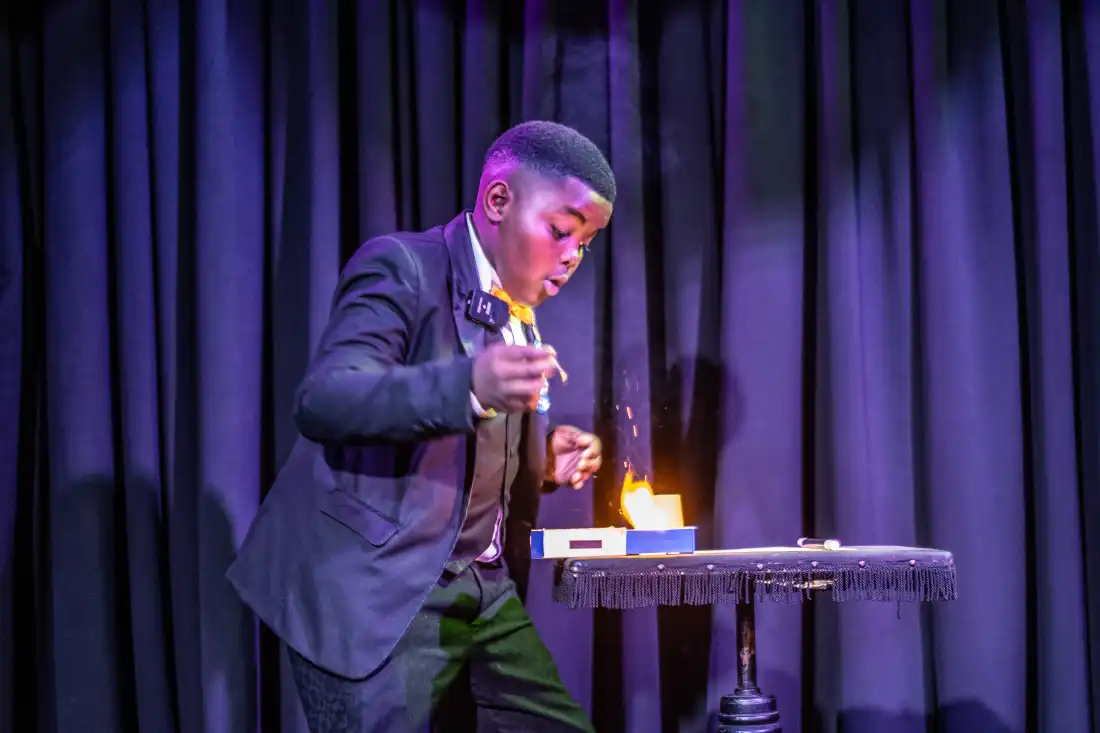
Lubelo Mthenjana, who’s 11, performs a magic trick involving fireplace through the annual junior magic contest on the School of Magic in Cape City, South Africa.
Tommy Trenchard for NPR
disguise caption
Tommy Trenchard for NPR
Wearing a pointy black three-piece go well with and a dapper yellow bow tie, Lubelo Mthenjana stands alone on a darkish stage, taking in the previous few seconds of quiet earlier than the curtain opens. He takes a deep breath as his identify is introduced. Then he opens his arms large and flashes a brilliant smile.
“Hey everybody! My identify is Lubelo Mthenjana, and I can be performing for you … some magic!”
The viewers of about 30 youngsters and fogeys is spellbound. They snigger out loud as he makes a string of paper clips vanish right into a plastic cup and gasp with shock because the clips reappear inside a matchbox. Then comes his greatest trick: He conjures sweets out of skinny air and tosses them into the gang. The room erupts. As Lubelo takes his closing bow to thunderous applause, his mother beams a proud smile on the 11-year-old apprentice magician.
On this cloudy Saturday morning in September, Cape City’s School of Magic is buzzing with vitality as dozens of scholars are competing within the annual junior magic contest. Heading to their school rooms, youngsters in prime hats, crisp white shirts and ties sprint up and down a staircase embellished with a riot of brightly coloured posters. On each flooring, show cupboards overflow with magic wands, sparkly hats, silk scarves, handcuffs, cube, Rubik’s Cubes, toys, pictures and dozens of trophies earned by college students in competitions everywhere in the world.
College students look at a set of trick enjoying playing cards throughout a category on the School of Magic, whose pupils are ages 10 to 18.
Tommy Trenchard for NPR
disguise caption
Tommy Trenchard for NPR
Aspiring magician Sibabalwe Sibaj, 17, juggles whereas using a unicycle.
Tommy Trenchard for NPR
disguise caption
Tommy Trenchard for NPR
Exterior the outdated red-brick Victorian mansion, framed by palm timber, two teenage boys zip across the automotive park on unicycles. Balls, golf equipment and diabolos shoot up into the air as a handful of youngsters apply juggling on the porch.
The Hogwarts of Cape City
Tucked away in a peaceable suburb, this extraordinary faculty is a real-world Hogwarts: Africa’s solely faculty for youthful stage magicians and illusionists. Each Saturday morning, about 190 starry-eyed college students ages 10 to 18 attend courses in all the pieces from puppetry, mime and clowning to juggling, card methods, illusions, mentalism, stage magic, theater manufacturing and escapology. “All the abilities that can make magician,” sums up David Gore, the college’s founder.
In 1980, Gore was learning regulation and paying his means by acting at personal magic exhibits when he and a good friend got here up with the concept of beginning a magic faculty.
David Gore based the Cape City School of Magic in 1980, defying apartheid period legal guidelines by educating multiracial courses. Within the many years since, the school has educated hundreds of magicians, illusionists and performers.
Tommy Trenchard for NPR
disguise caption
Tommy Trenchard for NPR
“We walked into our native newspaper home with our prime hats and tails, advised our story about how we have been beginning the School of Magic, did magic for the journalists within the newsroom, and so they revealed an article,” he remembers. “From that article, we had 34 younger individuals who began attending formal weekly courses learning magic.”
On the time, South Africa was nonetheless within the grip of apartheid, a brutal system of racial segregation that dictated nearly each facet of day by day life. State colleges have been strictly segregated. College students of various races couldn’t even share park benches, some constructing entrances or take the identical public transport to high school. But the School of Magic was multiracial from day one.
The School of Magic College students are entranced by a category on close-up magic.
Tommy Trenchard for NPR
disguise caption
Tommy Trenchard for NPR
“After we began out, our group was unlawful,” says Gore, referring to its no-segregation coverage. “This was a possibility for younger folks from all backgrounds to come back collectively round a typical curiosity in magic, to find out about one another and perceive one another.”
Almost 50 years later, the college continues to face out in a metropolis nonetheless deeply divided alongside racial and financial traces.
“Lots of our younger folks stay siloed of their socioeconomic teams, fairly often alongside both language or racial traces,” Gore explains. “Some arrive in very fancy automobiles, others have taken an hour in a collective taxi to get right here. However once they’re right here, they work with the identical tools, the identical courses, the identical phases and get the identical meals.”
Although the six-year course prices a price, about 80% of the scholars can’t afford to pay and are sponsored, principally by personal donations.
How do you grasp the humanities of juggling and spinning plates? Follow, apply, apply.
Tommy Trenchard for NPR
disguise caption
Tommy Trenchard for NPR
“Magic is such a beautiful companion for our younger folks right here in South Africa,” says Gore. “They’re capable of carry it of their pockets, into the communities and the marginalized areas the place most of our college students come from. It is an artwork kind that may be carried out with out being rich or needing very costly devices.”
A number of research have discovered that studying magic may also help youngsters develop vanity, curiosity, lateral pondering, advantageous motor abilities and problem-solving talents. A 2021 examine performed by researchers on the Universities of Hertfordshire and Edinburgh discovered that youngsters who realized and carried out a magic trick confirmed better enhancements in inventive fluency and originality than those that accomplished an identical artwork exercise.
Themba Van der Westhuizen, 12, practices a magic trick on a schoolmate on the School of Magic. Van der Westhuizen says he enjoys impressing family and friends along with his methods and that studying to turn into a magician has boosted his self-confidence.
Tommy Trenchard for NPR
disguise caption
Tommy Trenchard for NPR
Even watching a magic trick can problem our assumptions concerning the world and stimulate extra unique pondering. In one other examine, researchers discovered that it stimulated areas of the mind related to cognitive flexibility and processing unconventional info.
On this photograph from 2021, Anele Dyasi, a former scholar and now trainer of on the School of Magic, reaches out to a white dove on the faculty’s dove enclosure. The faculty has since stopped utilizing animals in its performances.
Tommy Trenchard for NPR
disguise caption
Tommy Trenchard for NPR
“Lots of our graduates do not turn into performers or magicians. However one of many abilities that this younger technology is most going to wish for his or her careers is creativity,” provides Gore. “That’s what’s so incredible about magic: Nothing’s unimaginable for us.”
A child who’s hooked on magic
For 11-year-old Lubelo, magic has “opened up a brand new world.” After watching a household good friend carry out a trick, he was decided to affix the School of Magic. He needed to wait till he turned 10 to enroll. Now, he is hooked.
At house in Makhaza township, about 40 minutes from the school, Lubelo spends his free time watching magic exhibits on-line and working towards methods on his brothers and fogeys. He retains his props, instruments and different secrets and techniques in a field hidden away in his room. He is even chosen a stage identify: Spade Boy — after his favourite card go well with.
Aspiring magician Lubelo Mthenjana is clearly the household star as they stand outdoors their house within the Khayelitsha neighborhood of Cape City.
Tommy Trenchard for NPR
disguise caption
Tommy Trenchard for NPR
“If my mother is cooking and asks me to move the potatoes, I am going to begin juggling with them,” he says mischievously.
Lubelo has additionally persuaded a number of pals to affix the college, turning into one thing of an envoy in a neighborhood the place magic is commonly frowned upon and related to witchcraft.
“Many individuals are afraid of magic. However on the School of Magic, we do not do darkish magic,” he explains. “We simply do the type of magic that makes any individual smile, makes them pleased and takes the stress away.”
Generally, he says, different youngsters ask whether or not he can flip folks into pigs. “Then I simply say: ‘Let me begin with you!’ and so they run away,” he laughs.
Lubelo’s mom, Yandiswa, says the magic classes have boosted her son’s confidence. They’ve introduced one other type of aid, too. “It retains him occupied and away from this surroundings and all the pieces that is occurring outdoors,” she says.
With practically 60 murders per day, South Africa has one of many world’s highest crime charges, and several other of Cape City’s townships are among the many areas hardest hit by violent crime. From his house in Makhaza, Lubelo usually hears gunshots. He says boys his age are drawn into utilizing and promoting medication.
The magic neighborhood hasn’t been spared. Just some weeks earlier than our go to, the college held a memorial service for Duma Mgqoki, a promising younger magician, former scholar and volunteer trainer who was killed in a capturing in July. He was 22.
On this photograph from 2021, Duma Mgqoki tries his hand at a card trick on the Cape City School of Magic. In 2026, Mgqoki was killed in a capturing within the Philippi neighborhood of Cape City. Lots of the School’s college students come from neighborhoods marked by unemployment and violent crime.
Tommy Trenchard for NPR
disguise caption
Tommy Trenchard for NPR
“On a weekly foundation, a few of our younger folks come to us saying they’ve skilled crime on a firsthand foundation,” says David Gore. “This stuff want to alter, and we’re very hopeful that the youthful technology of at present are going to be the power of change to carry concerning the society which all of us want to reside in.”
College students from the Cape City School of Magic do their magic trick homework within the Mfuleni neighborhood the place they reside.
Tommy Trenchard for NPR
disguise caption
Tommy Trenchard for NPR
Again on the school, after ending his present, Lubelo steps off the stage to a refrain of fist bumps and backslaps from his excited pals.
“He was so good! We’re swimming in happiness!” one teenager beams. With out skipping a beat, the boys run outdoors, decide up colourful leather-based balls and launch right into a juggling competitors.
Lubelo Mthenjana begins his efficiency through the annual junior magic contest on the School of Magic. Spoiler alert: He gained in his age class!
Tommy Trenchard for NPR
disguise caption
Tommy Trenchard for NPR
Unicycles and prizes
By now, a lightweight drizzle has set in, however the two unicyclists are nonetheless making their rounds within the automotive park, seemingly undeterred. “Even when the storm comes, even when the world ends, I am going to by no means cease unicycling,” declares 14-year-old Joshua Clyde as he whizzes previous.
Contained in the cafeteria, a wide-eyed crowd has gathered round a trainer displaying off a magic trick. With a snap of his fingers and what looks as if a contact of superhuman energy, he makes a coin disappear from a scholar’s closed fist. It reappears beneath the scholar’s watch.
Others have opted for the puppeteering class, upstairs, the place pairs of scholars are taught to carry their humanoid puppets to life.
Puppets are a part of the curriculum on the School of Magic. Trainer Jesse Brooks shares his puppet mastery with 12-year-old Okuhle Ntshutshe.
Tommy Trenchard for NPR
disguise caption
Tommy Trenchard for NPR
Footsteps drum up and down the staircase because the remaining performers on this Saturday competitors rehearse their routines, nerves and pleasure mounting. “Why am I so nervous? I’ve received this!” says bubbly Kungentando Ndenetya, 12, repeating the mantra to herself.
Aspiring magician Kungentanda Ndenetya performs through the annual junior magic contest on the Cape City School of Magic.
Tommy Trenchard for NPR
disguise caption
Tommy Trenchard for NPR
As soon as each little one has carried out, the jury retires to a quiet workplace to deliberate. All 4 judges are former college students or lecturers on the School of Magic. Twenty-five-year-old Caitlin Hutchison, who comes from “a protracted line of magicians,” says the college taught her “resilience coaching.” Monica Nyakatya graduated in 2009 and now works in logistics however has remained near the establishment that, she says, “formed” her.
The judges on the annual junior magic contest applaud after a efficiency on the School of Magic in Cape City, South Africa.
Tommy Trenchard for NPR
disguise caption
Tommy Trenchard for NPR
The deliberations are strictly confidential. When the judges return, everybody gathers within the small theater. The younger magicians maintain palms, ready anxiously because the outcomes are introduced. Then comes Lubelo’s age group.
“In first place, Lubelo Mthenjana!”
Prestidigitation pupil Lubelo Mthenjana adjusts his bow tie. Lots of the School’s college students sport conventional magician apparel like bow ties and prime hats.
Tommy Trenchard for NPR
disguise caption
Tommy Trenchard for NPR
Beaming, he strides onto the stage to shake every choose’s hand — then runs into his mom’s arms.
As quickly as he will get house, he’ll apply his latest methods.
For tales about life in our altering world, subscribe to NPR’s World Well being publication.
Julie Bourdin is a contract journalist primarily based in South Africa and France. She covers human rights and climate-related tales throughout Africa and past.
Tommy Trenchard is an impartial photojournalist primarily based in Cape City, South Africa. He has beforehand contributed photographs and tales to NPR on the Mozambique cyclone of 2019, Indonesian demise rituals and unlawful miners in deserted South African diamond mines and gained a World Press Photograph prize for the photographs in his story for NPR on clashes between elephants and other people in Zambia.