Dwelling with real-time progress in lung most cancers therapy : NPR
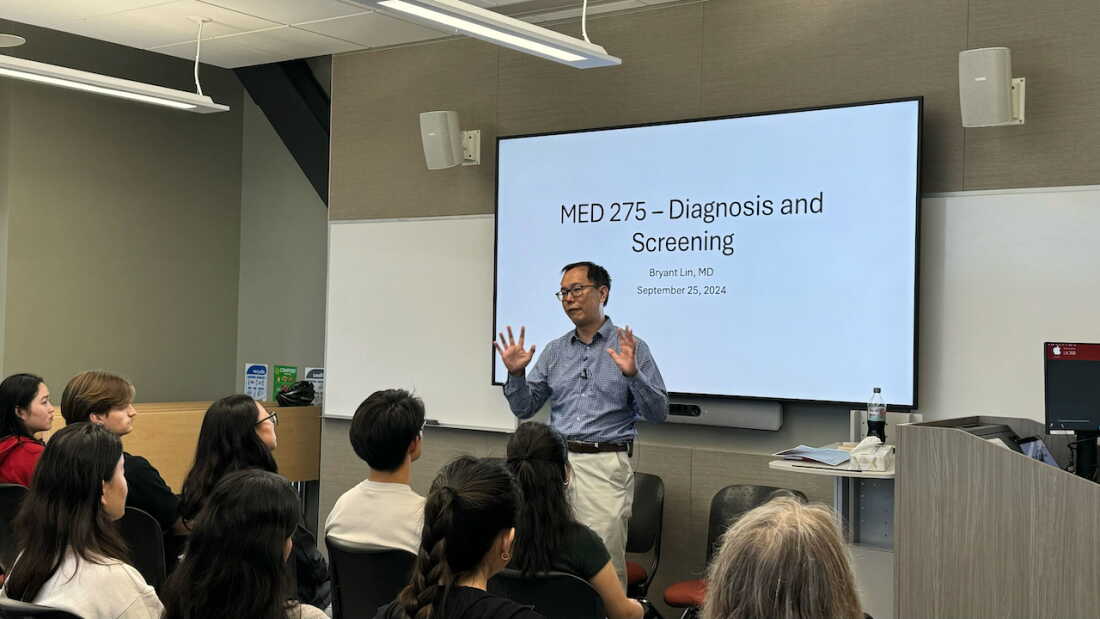
Dr. Bryant Lin teaches a lung most cancers class in fall 2024. He says he was very nervous to show the primary class and share his story.
The Lin household
disguise caption
toggle caption
The Lin household
Stanford medical professor Bryant Lin based the varsity’s Heart for Asian Well being Analysis and Schooling, advocating for higher lung most cancers screening particularly. Then two years in the past Lin grew to become a Stage IV affected person of the very illness he lengthy crusaded towards.
“Tremendous ironic that I might be co-leading the middle that helps analysis and schooling on this illness, and I get identified myself,” he says.
Lin, who’s a non-smoker, tells college students he considers himself fortunate — even hopeful: “I believe the longer term is de facto vibrant, as a result of we’re creating all of those customized, specialised precision therapeutics for lung most cancers,” he says.”My hope is that if we’re not in a position to treatment lung most cancers, we are able to not less than flip it right into a persistent illness.”
Notable enhancements are shifting the prognosis for a illness as soon as thought-about a demise sentence. A lot of the current progress is so new, it is just beginning to shift the statistics on survival. Whereas the five-year survival charge throughout all phases of lung most cancers has doubled in three many years, it nonetheless stays at a low 30%. (Stage of illness makes an enormous distinction; early, localized most cancers survival charges over 5 years was 67% between 2015 and 2021.)
Focused therapy
The genetics of lung cancers are very various and sophisticated relative to different cancers, making it traditionally difficult to deal with. One key technological growth underlying many new therapies is the power to establish, by means of genetic testing, the precise mutation driving an individual’s irregular cell progress, based on UCLA oncologist and researcher Jonathan Goldman. “We will choose a drug that is actually been developed for that sort of most cancers,” he says.
Not solely can that handle and even shrink tumors, as a result of the medicine are higher focused, in addition they trigger much less collateral harm, making unintended effects usually extra tolerable for sufferers.
“Survival was once underneath a yr, and now it is usually a number of years and generally a few years,” Goldman says.
Whether or not it is breast, liver or lung most cancers, concentrating on therapies by genetic subtype is much simpler than generalized therapies of the previous, Goldman says, as a result of the medicines are designed to focus their assault on particular mutated cells driving the irregular progress. Because the medicines are focused, in addition they are inclined to have fewer harsh unintended effects in comparison with chemotherapy.
Need the most recent tales on the science of wholesome residing? Subscribe to NPR’s Well being publication.
Checks to establish a affected person’s particular most cancers subtype – a process referred to as complete genomic testing – are already out there, and Goldman served as principal investigator on a current research printed within the New England Journal of Medication, exhibiting dramatic reductions in recurrence, when sufferers with uncommon subtypes obtain focused medicines as their first therapy.
Nonetheless, entry to such testing is spotty. Goldman says fewer than half of lung-cancer sufferers within the U.S. get their most cancers genetically examined previous to therapy as a result of that analysis shouldn’t be but thought-about “customary of care.” Plus, medical doctors themselves is probably not conscious it exists; Goldman says therapy know-how is altering so quickly, basic oncologists is probably not up-to-date on among the most up-to-date developments particular to lung most cancers.
“The subsequent step isn’t just these scientific discoveries, however studying tips on how to implement these findings,” he says. “We have confirmed time and time once more how necessary and efficient it’s to get this testing finished early so you may choose your greatest therapy first.”
It was a type of comparatively new focused medicine, a day by day capsule referred to as Tagrisso (or osimertinib), that professor-patient Bryant Lin initially started taking when he was first identified in Might 2024. Simply three months previous to that, the Meals and Drug Administration authorized its use together with chemotherapy, based mostly on information exhibiting it lengthened survival.
“I’m a beneficiary of years – of many years – of analysis,” Lin says, noting how his therapy routine has intently mapped with among the most up-to-date drug developments. “Since I have been identified. It is fairly superb how fast – how speedy – our advances have been occurring.”
Affordability
Therapy is one factor; affording them is one other. Even Lin, a affected person with the weird privilege of being a nationally identified skilled at an elite medical middle, faces battles with insurance coverage to get a few of these new, costly therapies lined. Insurers virtually at all times require prior authorization for the therapies, or deny protection for brand spanking new medicine that have not but acquired skilled endorsement as customary protocol. Lin says this occurred for considered one of his $16,000 medicine, delaying his therapy at a crucial time. He watches sufferers, too, battle comparable battles over protection.
“Oral medicine and the IV medicine — they’re tons of of hundreds of {dollars},” he says. “I do not know too many individuals who may afford to pay out of pocket.”
A yr into his therapy, the preliminary focused remedy Lin was taking stopped working. By then, regulators authorized one other drug mixture – amivantamab and lazertinib – an antibody to activate the immune system, and a distinct capsule concentrating on his particular mutation sort, often called EGFR.
Dr. Bryant Lin receives a chemo infusion within the early days of his therapy in June 2024.
The Lin household
disguise caption
toggle caption
The Lin household
Lin, who nonetheless teaches, travels, and advises the Susan Wojcicki Basis for lung most cancers, says these new therapies have given him each extra life, and considered one of higher high quality. “My signs are very well managed. I can reside my life. I can converse. I do not assume I’ve coughed as soon as in our dialog.”
What’s extra, there is a compounding impact with this sort of scientific progress, the place current breakthroughs with different genetically comparable cancers could quickly apply to lung most cancers.
Customized therapy
One promising space of potential crossover is with pancreatic most cancers, which is pushed by a gene in the identical KRAS household that causes a large minority of lung cancers. One drug the FDA authorized in August referred to as Rasonque (generic title daraxonrasib), doubled survival for late-stage most cancers sufferers to over 13 months in scientific trials – a uncommon victory towards pancreatic most cancers, a very cussed type of the illness.
There are different promising medicine for pancreatic most cancers which will finally discover utility towards lung most cancers as effectively, together with mRNA vaccines — customized to match the genetic profile of every particular person’s most cancers. Researchers and firms say these present promise re-enlisting the immune system into preventing tumors.
“I have been investigating that for myself – customized mRNA vaccine,” Lin says.
Lin’s skilled focus stays on advocating for higher modes and charges of screening, which stays at a stubbornly 18% among the many high-risk sufferers for whom annual, low-dose CT scan screening (picture assessments) is the usual advice. However with screening, too, there’s progress: AI imaging and more and more delicate blood assessments could assist detect, and even predict, formation of illness even years earlier.
Simply as colorectal cancers can now be screened for utilizing blood, stool and colonoscopy assessments, Lin desires to see choices moreover the CT scan for lung most cancers. Increasing these sorts of surveillance applied sciences may finally do extra to scale back lung most cancers deaths.
Lin himself is sort of a trapeze artist, grabbing maintain from one therapy to the following. A fellow most cancers affected person informed him: All he wants is to do is grasp on. “He says, ‘Hey, you solely must survive lengthy sufficient till the following new therapy comes out’ – and that is been the case for me,” Lin says. His lifetime of limbo entails balancing acts – as physician and affected person, as optimist and realist. “I am hopeful,” he says. “However, completely: The chances are towards me.”
Dr. Bryant Lin along with his sons at a San Francisco Giants baseball sport in spring 2025. He says he cherished going to Giants video games along with his sons earlier than getting identified. “Fortuitously, we now have been in a position to go once more as a household in 2025 and 2026,” he says.
The Lin household
disguise caption
toggle caption
The Lin household
Certainly, days after we spoke, Lin acquired disappointing information his newest scans confirmed development of his most cancers. So he now should think about switching to a distinct antibody drug authorized final yr, or the opportunity of new scientific trials.
Within the meantime, Lin additionally retains his deal with catching San Francisco Giants video games along with his spouse and teenage sons, or tinkering with an old style, seafoam-green Smith Corona handbook typewriter he purchased to commemorate his upcoming guide, Sunshine: An exploration of residing if you end up dying.
“We stayed up late once we obtained the typewriter, simply banging away, making the noises and writing loopy issues on the paper.”
Life, he insists, nonetheless must be lived with a little bit of silliness.