Historic enamel pose a thriller. The reply is likely to be: betel nuts : NPR
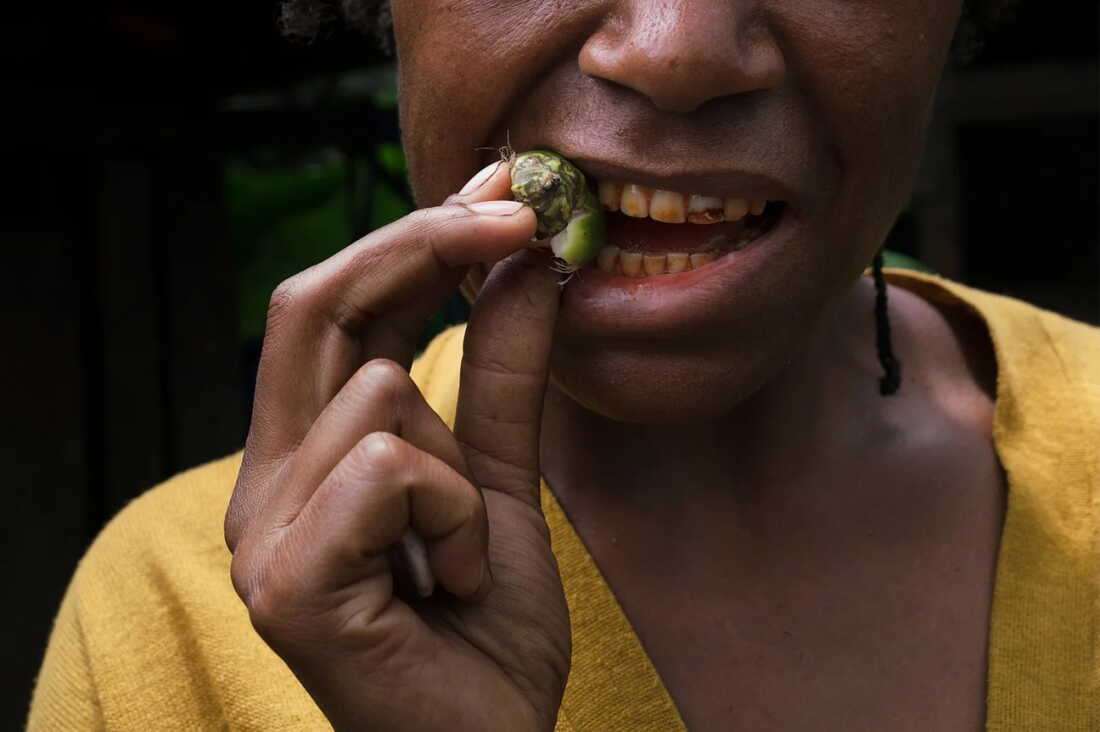
A lady cracks the hull of a betel nut along with her enamel to get to the meat to chew.
Claire Harbage/NPR
cover caption
toggle caption
Claire Harbage/NPR
About 600 million folks in the present day chew on betel nuts —- the brownish inexperienced seeds of sure palm bushes which might be concerning the dimension of a walnut. Betel nut customers say they get all types of advantages — aid from indigestion, recent breath, an power enhance.
The medical group notes that long-term betel nut use can injury enamel, improve the danger of coronary heart illness, and result in oral most cancers because of the chemical compounds inside.
Nonetheless, many individuals in Asia and the Asian Pacific are hooked on chewing them. Betel nuts are thought-about the world’s fourth mostly used mind-affecting substances, after tobacco, alcohol and caffeine.
A brand new examine, revealed in Science Advances, finds this love affair with betel nuts is nothing new. In truth, it is seemingly very, very previous. By taking a look at historical enamel, researchers uncovered what they suppose is an early stage within the apply, when hunter-gatherers had a behavior of sucking on betel nuts, presumably for his or her painkilling results.
“It is an opportunity archaeological discovery that reveals an preliminary stage within the improvement of this widespread drug used in the present day,” says Adam Brumm, a professor of archaeology at Griffith College in Australia who led the analysis, “We expect it might need began with hunter-gatherers simply sucking on the nuts, virtually as if they have been gobstoppers.”
Exterior researchers discover the proof compelling although not conclusive — and additional observe that drug use has longstanding and deep roots amongst humanity: The intuition to experiment and broaden our horizons with substances is a part of human nature, says José Capriles, affiliate professor of anthropology at Penn State College, who has discovered medication utilized by people a thousand years in the past in South America.
Puzzled by “unusual grooves”
How did scientists uncover this historical betel nut utilization? The reply includes two puzzling units of enamel, pretend saliva — and a few private experimentation.
On an archaeological dig in Sulawesi, an island in modern-day Indonesia, Brumm and his colleagues excavated some very previous human stays.
They belonged to a hunter-gatherer who lived way back to 25,000 years. The stays posed a thriller. “There have been actually unusual grooves within the enamel that we could not clarify,” Brumm says.
He emailed different archaeologists — “the entire world’s main specialists in historical dental put on” — soliciting their recommendation. “None of them may clarify how these grooves may have shaped,” says Brumm.
About 20 miles to the east, they discovered a second set of enamel from a human who lived as much as 8,000 years in the past, with comparable marks. “The grooves have been so deep that they’d really uncovered the pulp cavity, the nerve heart, of a number of enamel,” Brumm says, describing it as a sample that seemingly took many years of repeated put on to type.
Whereas hunter-gatherers from that point are identified to have used their enamel as instruments — holding, breaking, stretching issues — none of these makes use of matched the grooves on these enamel. “We dominated out any sort of meals they could have been consuming, we dominated out the chance that they have been processing plant fibers to make string of their mouth,” says Brumm.
Brumm was stumped. Then he remembered one other instance of distinctive enamel put on, from the colonial interval in Europe, America and Australia, when laborers habitually smoked tobacco from clay pipes. “They’d have the pipe protruding of their mouth, Popeye-style,” Brumm explains, “Over a lifetime of this behavior, they have a superbly spherical notch of their enamel you can slot the clay pipe stem straight into.”
Brumm and his colleagues thought the enamel grooves from Indonesia would possibly originate in the same behavior, one grounded in cultural practices.
The case for the betel nut
Within the Asia and Pacific area in the present day, betel nuts are generally chewed with different chemical compounds for his or her mixed stimulant results.
Nevertheless, the damage patterns on the enamel have been in keeping with sucking — not chewing — arduous, spherical abrasive objects over a few years, Brumm says. He and his colleagues suppose they’ve uncovered an early developmental stage within the apply. “We expect they have been hooked on nut-sucking,” Brumm says. Since sucking betel nuts shouldn’t be widespread in the present day, Brumm partnered with Professor Roger Papke, a neuropharmacological researcher on the College of Florida, to check whether or not the motion may trigger a drug impact historical people could have desired.
“We soaked complete betel nuts in synthetic saliva, after which launched the resultant extracts into frog egg cells engineered to supply human mind receptors,” Brumm says. They discovered that the synthetic saliva efficiently extracted arecoline, an lively chemical within the betel nut, and that the mind receptors turned on once they touched the saliva. “We have proven that in the event you simply suck on the nut, there is a physiological response that may be launched into your bloodstream after which into your mind, and that may alter human mind perform,” he says.
Then they sought to determine that these historical folks really did it. Along with matching the form of betel nuts to the grooves within the enamel, they examined the dental tissues and located traces of arecoline — for which betel nuts are the solely identified pure supply, Papke says.
Brumm additionally put himself within the mindset of historical people and tried sucking on betel nuts himself. “I needed to give it a go,” he says, “If you happen to gently gnaw on the surface of it, it releases the betel juice. It has this extraordinarily bitter and astringent style that makes your complete mouth go numb.”
He hypothesizes that the numbing, pain-relieving impact was what historical hunter-gatherers have been after. Brumm thinks the betel nut suckers finally wore their enamel right down to the nerve — which he says may have been very painful — resulting in extra nut-sucking to alleviate the ache. “They have been primarily caught on this cycle they usually have been principally hooked on this pure plant drug,” Brumm says.
Human nature
Exterior researchers say the paper makes a compelling case for historical betel nut use. “There’s proof for the betel nut inflicting extreme tooth put on. While you add the chemical proof, that is just about a smoking gun,” says Peter Ungar, a distinguished professor of anthropology on the College of Arkansas who research enamel and was not concerned on this examine.
“It matches with the larger image of our understanding of betel [nut] use and in addition the cultural dynamics of that point interval,” says Agustín Fuentes, professor of anthropology at Princeton College.
Others wish to see further assist for the idea. “I want there was extra, I have to admit — there are two skeletons that they report,” says Capriles at Penn State.
Capriles acknowledges that well-preserved historical human stays are arduous to seek out, particularly in tropical areas the place the warmth and humidity breaks them down. Nonetheless, “extra direct proof can be the precise discovering of the nuts, of the seeds, ideally in some type of cultural context,” resembling a fire, home flooring or burial website, he says.
And archaeologists not concerned with the examine are cautious of creating assumptions as to why historical folks have been drawn to betel nuts. “We’ve to be very, very cautious to not affiliate our explicit assumptions of ache or patterns,” says Fuentes, of Princeton. Relating to the researchers’ idea that historical peoples have been hooked on betel nuts for his or her painkilling results, “I feel they’re utilizing a recent public well being and dentistry strategy to consider very difficult cultures of the previous.”
There might need been different social and cultural causes for the teeth-damaging apply, Fuentes says. In spite of everything, folks in the present day eat arduous sweet, open bottles with their enamel, neglect to brush and floss. “All of this stuff will not be instantly good on your enamel, however they serve different social [purposes] in different kinds of contexts,” he says.
Brumm, the lead researcher, acknowledges there are limitations to the work. “As all the time with archaeology, you are coping with huge unknowns,” he says, “However we have put loads of thought into this, and we expect that is what was occurring.”