Republican candidates say they’re healthcare champions regardless of cuts : NPR
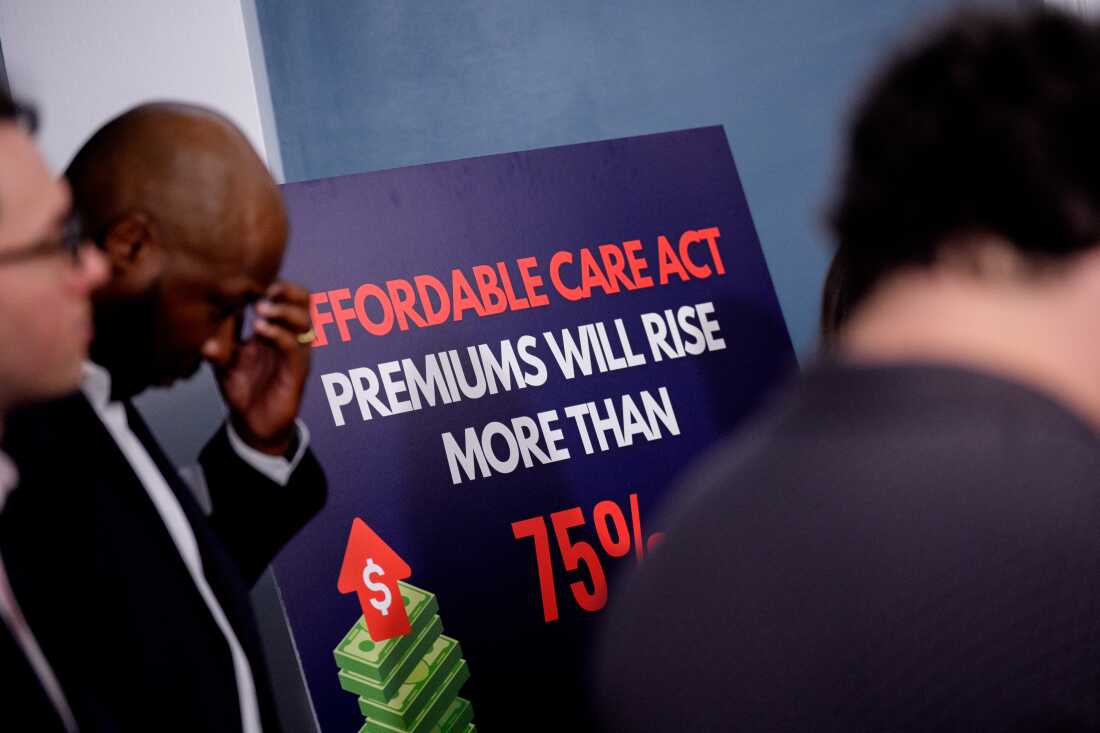
An advert from Rep. David Valadao, R-Calif., highlights affordability challenges for healthcare.
Andrew Harnik/Getty Photos
disguise caption
toggle caption
Andrew Harnik/Getty Photos
Republicans campaigning in swing districts are working advertisements about healthcare after dealing with criticism of the cuts within the One Large Stunning Invoice Act. Many of those advertisements goal voters over 35 years previous and concentrate on three matters: Medicaid fraud, rural hospitals and affordability.
An NPR evaluation checked out video advertisements on YouTube that ran this midterm cycle, lots of which mirror advertisements on different digital platforms and on tv. The evaluation consists of promoting for candidates in races which are toss-ups or leaning towards one celebration or the opposite, as rated by the Prepare dinner Political Report.
This can be a shift for the Republican Celebration. Jonathan Oberlander, a healthcare coverage skilled on the College of North Carolina, stated repealing the Reasonably priced Care Act (ACA), generally known as Obamacare, was “goal No. 1” for Republican lawmakers after Trump was first elected in 2016. When the Senate didn’t repeal the laws, there was nonetheless main backlash towards Republicans for making an attempt to take action within the midterms.
“[The repeal is] most likely one of many components that led them to lose their majority within the Home,” he stated of the 2018 midterm election, the place Democrats received a decisive majority. “It was terribly unpopular, the least fashionable main laws of the previous 40 years.”
With the passing of the One Large Stunning Invoice Act final 12 months, there at the moment are stiffer necessities for insurance coverage and decreased funding for state applications. About 10 million fewer persons are anticipated to have medical insurance in 2034, in response to a report by the Congressional Funds Workplace.
There have been about 3 million fewer individuals enrolled by way of the medical insurance exchanges in early 2026 than when the invoice handed, in response to the Facilities for Medicare & Medicaid.
Since then, Republicans have didn’t get well on the problem, with solely a 3rd of complete voters approving of the Trump administration’s dealing with of the price of healthcare, in response to KFF’s most up-to-date ballot on the problem from April.
Republican candidates are addressing the unpopular reforms early, in response to Daniel Hopkins, a professor of political science on the College of Pennsylvania.
“[Congressional Republicans] know that that is going to be a potent line of assault from their challengers they usually should get in entrance of it and defend it,” he stated.
Reforming Medicaid as a energy
Rep. Mike Lawler, a Republican working for reelection in a toss-up seat in New York, ran advertisements on reforming Medicaid, saying the legislation — which he voted for — decreased the variety of able-bodied people in this system. He is additionally raised the false declare that undocumented immigrants can now not obtain advantages (they don’t seem to be underneath a “certified standing” to obtain advantages), a subject that performs properly with the Republican base.
Specializing in reform performs right into a energy of the Republican Celebration. Based on KFF, Republicans outperform Democrats on “addressing fraud and waste in authorities well being care applications” when respondents rated which celebration they belief extra in several areas of healthcare coverage.
“What Republican voters need to see from their lawmakers is modifications to the Medicaid program,” Ashley Kirzinger, the director of survey methodology at KFF, stated.
“They do not need this system to go away, however they need it to cut back fraud in order that this system is extra sustainable.”
Notably, round a 3rd of impartial voters persistently stated they do not belief both celebration on addressing prices of healthcare, pharmaceuticals, retaining company pursuits out of medical care or addressing fraud and waste.
Funds into rural hospitals
Rural hospitals have the best threat, as a result of they depend on funding that was a part of Medicaid enlargement within the ACA. Many counties in Lawler’s dwelling state are already in a healthcare disaster, in response to a report from the New York State Comptroller final 12 months.
In response to criticism over cuts to rural hospitals, Congress included the Rural Healthcare Transformation Act (RHTA), co-sponsored by Lawler, within the One Large Stunning Invoice Act. The $50 billion in funding from the RHTA does not offset the $137 billion in Medicaid cuts that might instantly have an effect on rural areas, although, in response to an evaluation by KFF.
There’s additionally an anticipated hole in implementation, with the specter of “clawbacks,” the place cash is taken again if states do not meet outcomes. That is inflicting states to take a cautious strategy to rolling out the applications. Lara Kassel, coordinator for Medicaid Issues in New York, sees a ready interval in protection for these faraway from Medicaid who’re ready for funding from the RHTA.
“It is an endeavor much like [other programs] the place it’s important to arrange a program, guidelines, have individuals apply, after which allocate the cash,” she stated.
Republicans are attempting to take management of the narrative. Maine Sen. Susan Collins has launched a sequence of advertisements mentioning that she directed $190 million in funds for rural hospitals in Maine.
Greater than 60% of Maine’s hospitals are in rural areas, one of many highest charges within the nation. Medicaid is essential in retaining rural hospitals working, protecting important companies equivalent to discharges and births. With greater than 4 in 10 hospitals in debt, cuts would have main penalties for these services.
“They’re sources of security, financial prosperity and jobs,” KFF’s Kirzinger stated. “Individuals in rural areas have a very sturdy connection to their hospital.”
Making healthcare inexpensive
Greater than half of People say that healthcare prices are a excessive fear for them when voting, in response to KFF, and Republican candidates are positioning themselves as fixers.
“Democratic lawmakers have been extra trusted on healthcare, and Republican lawmakers have been extra trusted on the financial system, so what occurs when it is an financial healthcare subject?” Kirzinger stated. “There is a chance to achieve that lane and be the celebration that folks belief.”
Three Republicans, Rep. Ashley Hinson, who’s working for U.S. Senate in Iowa, and Reps. Mariannette Miller-Meeks, additionally of Iowa, and David Valadao, of California, who’re each working for reelection of their districts, have made healthcare affordability a part of their marketing campaign messaging. All three are working in states or districts which have shifted away from Republicans previously 12 months (although Valadao’s district was additionally redrawn in California’s redistricting final 12 months), in response to the Prepare dinner Political Report. Miller-Meeks and Valadao are working in districts now seen as toss-ups.
Hinson and Miller-Meeks directed blame for medical prices towards insurance coverage and pharmaceutical corporations, organizations with traditionally low approval rankings. Hinson pointed to working with Trump to decrease healthcare prices, whereas Miller-Meeks, a medical physician, highlighted her experience in difficult pharmaceutical corporations.
In California, Rep. Valadao ran advertisements promising to decrease prices and defend Medicare and Medicaid. Valadao voted for the OBBBA.
A report by the City Institute reveals that ACA premiums have risen nationwide 21.7% between 2025 and 2026. Healthcare coverage skilled Jonathan Oberlander says that is linked to the Trump administration’s hands-off strategy towards the healthcare trade.
“[Republican] coverage, each on the One Large Stunning Invoice and never renewing the improved subsidies and guidelines and laws, has been to make it more durable for individuals to get medical insurance protection by way of the Reasonably priced Care Act and thru Medicaid,” he stated. “While you take Medicaid away from individuals, whenever you take these enhanced subsidies away, it actually will increase the prices that they face.”
Wanting ahead
The vast majority of the modifications and cuts enacted within the One Large Stunning Invoice are anticipated to enter impact after the midterm elections. Whereas some healthcare cuts have already gone into impact, such because the removing of ACA premium tax credit, many different necessities will start subsequent 12 months, equivalent to frequent redeterminations of eligibility and work necessities, in response to Medicaid Issues’ Lara Kassel.
Key modifications, just like the discount of Medicaid funding, do not happen till after this 12 months’s midterms, so candidates see this as a chance to emphasise different, fashionable components of the legislation, like tax cuts. Nonetheless, Republican lawmakers are laying the groundwork for blame if the opposing celebration features energy sooner or later, in response to political scientist Daniel Hopkins.
“A few of the key modifications, as an example, [like] the reductions in Medicaid funding, are scheduled to kick in years down the street,” he stated. “That point disconnect makes it actually onerous for voters to tangibly really feel and react to modifications which are sooner or later.”
That delay will possible arrange healthcare to be a prime subject for the 2028 election, the place Democrats are anticipated to assault Republicans on the fallout and each events can have open primaries for the presidency.
“That phasing gives a little bit of a buffer for Republicans from the political ache of those cuts,” Oberlander predicted. “[The healthcare cuts will] be totally uncovered in 2028.”